Drop punt analysis from one clip on your phone
See your kick. The phases found, the angles measured, one provisional mechanics score.
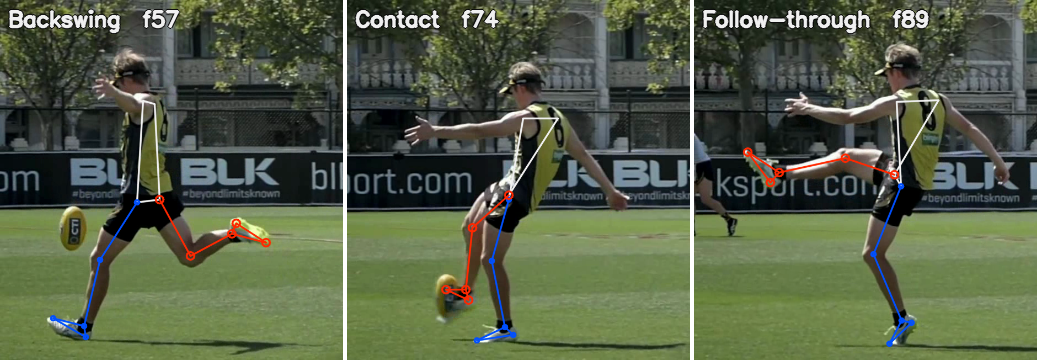
TrueBoot uses computer vision to track your body and the ball frame by frame in a side-on video of your drop punt. It finds the drop, backswing, plant, contact and follow-through, measures the angles and timings at each, scores your mechanics 0–100 and writes plain-English notes on what to keep and what to work on.
Key metrics
What TrueBoot measures
Measured from the pixels of your clip — not estimated, not typed in. Each one carries its own confidence.
Features
What you get from one upload
Built for a player at training with a phone and a mate, and for a coach who wants numbers to go with their eye.
Phase detection
The drop, max backswing, support-foot plant, contact and follow-through end — each pinned to a frame on your footage. Contact is fixed by the ball's change of direction, not a guess.
Skeleton video
Your clip played back with the tracked body and ball drawn on every frame, so you can see exactly what was measured and where. Step it frame by frame at contact.
Mechanics score
A 0–100 score across five areas — ball drop, leg sequence, support leg, contact, follow-through — scored on how well the kick was executed, never on how much it looks like someone else's.
Coach's notes
Strengths, up to three things to work on, and a cue or drill for each — written from your measurements. If a number isn't reliable, it isn't used as evidence.
Repeatability
Upload five or more kicks from one session and see what changes between them — the drop, the plant, the timing. That's what a good coach watches for, and one kick can't show it.
Footage check
Angle, stability, frame rate, whether the ball's in shot. If the clip can't support a measurement, you're told before you see a score — not after.
How it works
How TrueBoot reads a kick
You film one drop punt side-on and upload it. TrueBoot runs a whole-body pose model over every frame to find your joints, and a separate detector to find the ball. From those two tracks it works out which leg is kicking, then finds the phases: where the ball leaves your hand, where the knee is cocked furthest back, where the support foot lands, the exact frame the ball changes direction off your boot, and where the follow-through ends.
At each phase it measures the kinds of angles and timings a biomechanist measures in a lab — knee and ankle angles, trunk lean, foot speed, where the support foot sits relative to the ball — but from a phone clip, in two dimensions. Every measurement is checked against how fast the joint was moving and how clean the tracking was around that frame, and gets a confidence from reliable down to not measurable.
Only then does it score. Each of the five mechanics areas is scored on signals that have a clear direction — a straighter drop is better than a wandering one, a support foot that stays put is better than one that slides — and the score is withheld entirely if the footage can't back it. Last, a language model writes the coach's notes from the measurements and their confidence. It explains; it doesn't compute.
Phone on a tripod, side-on to your kicking leg at about hip height, far enough back that your whole body is in frame from the drop to the follow-through. Normal 60 fps video, not slow-mo, and a ball that stands out from the grass. Five or more kicks from the same spot unlocks repeatability.
What makes it different
Measured, not guessed
- Numbers from the pixels. Body and ball tracked frame by frame; angles and timings measured, not described by a chatbot looking at a video.
- A confidence on every measurement. Reliable, usable, moderate, or not measurable — and “not measurable” is shown, never papered over.
- No invented perfect angles. Published research is context beside your numbers, never a target to hit. Good kickers differ.
- Shows its work. The skeleton is drawn on your real frames. If it tracked the wrong leg, you'd see it.
- One thing, done properly. AFL drop punt, side-on. No 20 sports, no 3D replays we can't back up.
The science
What the research says — and doesn't
The drop punt has been studied in motion-capture labs: how accurate kickers differ from less accurate ones in knee angle at contact, foot speed, where the support foot lands and how the ball is dropped. TrueBoot shows those findings next to your measurements so you can see where a group of accurate kickers sat.
But lab studies measure in 3D with markers on the skin, and a phone clip is a 2D projection. The numbers aren't directly comparable, so TrueBoot never scores you on distance from a research value. Research is context. Your score comes from how well the kick was executed on the day, and your baseline comes from your own kicks over time.
Referenced in the app
- Dichiera et al. (2006) — kinematics of the drop punt in accurate vs less accurate kickers
- Blair et al. (2020) — lower-limb mechanics of the AFL drop punt across skill levels
- Ankle stiffness and foot speed at ball contact in skilled kickers
- Foot velocity by kicking task — distance vs accuracy
Not claimed
- 3D joint angles, spin rate, ball flight or goal accuracy — a side-on 2D clip can't measure them, so TrueBoot doesn't pretend to.
FAQ
Common questions
What do I need to film?
A phone, a tripod (or a bag to wedge it in) and a side-on view of your kicking leg at about hip height. Normal 60 fps video, whole body in frame from the drop to the follow-through. One kick per clip is ideal; a long recording with several kicks also works — TrueBoot splits it.
Does it work on front-on or behind-the-kicker footage?
Side-on is the main view — it's where knee, ankle, backswing and drop height are visible. A clip filmed from directly in front (the kick coming straight at the camera) gets the front-on view, currently in beta: it measures the accuracy side of the kick instead — where the ball is dropped relative to the kicking line, how the foot swings through, whether hips and shoulders are square, head over the ball, the guiding and balance arms. Footage from behind the kicker, or from an angle in between, is checked and told what it can't support rather than guessed at.
Is the score comparing me to a pro?
No. The mechanics score is about how well this kick was executed — straight drop, stable plant, leg through the ball. Research values from accurate kickers are shown for context, but they come from 3D lab capture and aren't a target.
What happens if the footage isn't good enough?
You get a footage check first: camera angle, stability, frame rate, whether the ball and the whole body were visible. Anything the clip can't support is marked “not measurable” and left out of the score. If too much is missing, the score is withheld and you're told why.
Who writes the coach's notes?
A language model, from the measurements and their confidence — not from watching the video. It's only allowed to cite measurements that were reliable, and it never invents a target angle.
What happens to my clips?
They're used to analyse your kick and shown back to you with the skeleton drawn on. During the beta they stay on TrueBoot's servers so you can revisit them; you can delete a kick or a whole session at any time.
How much does it cost?
The beta is free for invited players and coaches. Pricing comes after the scoring has been validated on real training footage — individual plans by number of uploads, and a club plan with private per-player profiles.
Private beta
Get in early
TrueBoot is being tested with a small group of players and coaches. Leave an email and you'll get an invite when there's a spot — and a say in what gets built next.
By joining you agree we can email you about the TrueBoot beta. Your address is used for nothing else and is deleted on request — see the privacy policy.